
Skipping steps is never the answer…
There are stages in the pattern-making process that leave very little room for negotiation. The prototype is one of them. Not because it’s mandatory by rule, but because this is where decisions stop being theoretical and become practical.
A pattern can be technically correct and still fail once it’s made, worn, and put into motion. The prototype exists to reveal that, before the problem spreads through the entire process.
So, what exactly is a prototype?
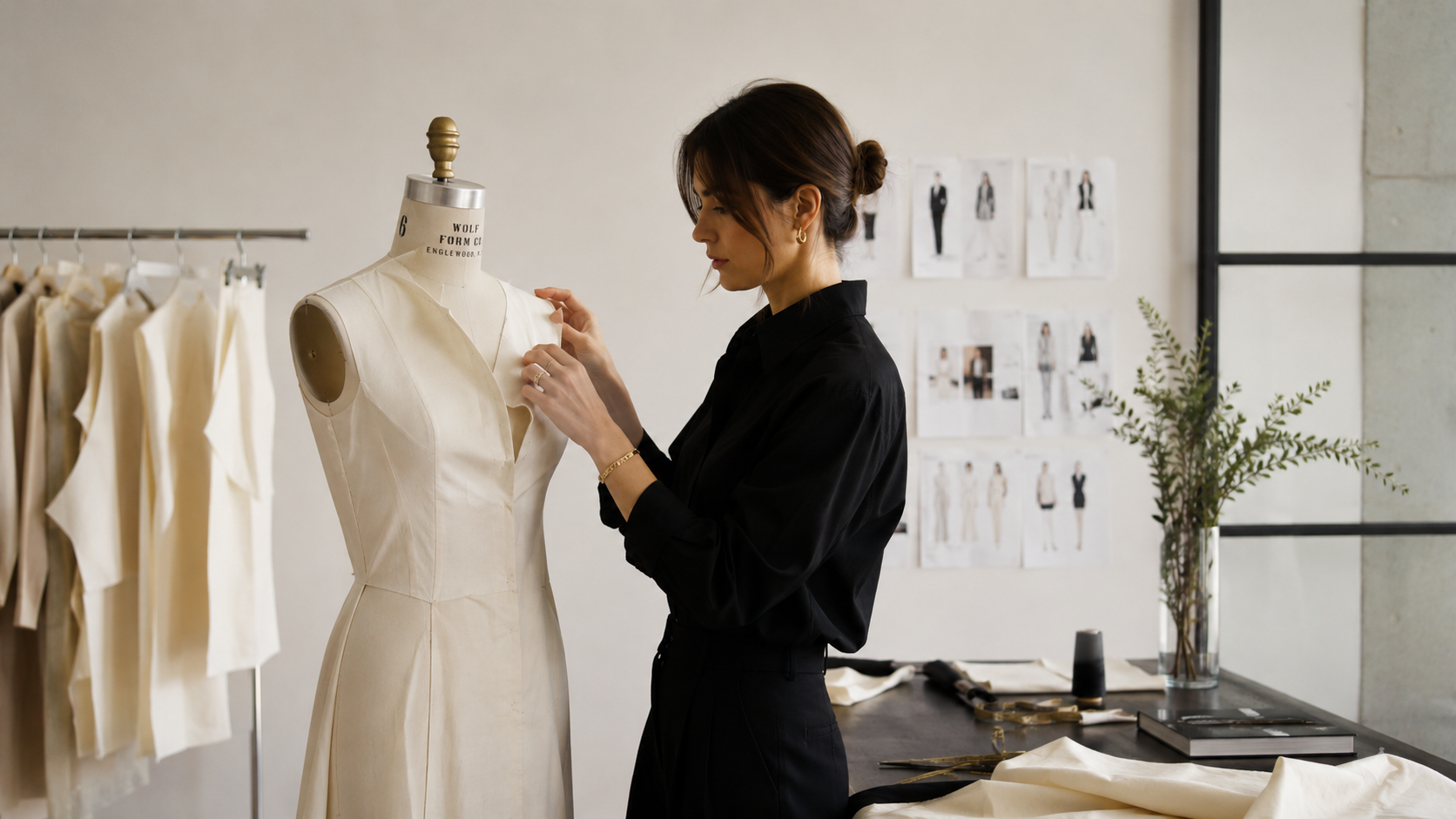
A prototype is a preliminary version of your pattern: a physical construction made in fabric that faithfully represents your design intent and fit before moving on to more costly steps like grading and production.
This is where you find out if the lines make sense beyond paper, if proportions are balanced, and if the construction actually works on the body.
Without this step, the base pattern remains just that, a well-drawn hypothesis.
It’s necessary to check whether the initial idea is viable
Very often, the idea is clear in our head, but the result on the body tells a different story. A prototype allows you to compare expectation and reality without filters.
This is the moment to adjust heights, widths, angles, and comfort points, when changes are still manageable and meaningful.
Checking the drape in the chosen fabric is crucial
Fabric changes everything.
Even fabrics that seem similar can behave in very different ways.
A prototype lets you observe how the garment reacts to weight, stretch, and structure. Lines that work perfectly in a lightweight fabric may fail in a heavier one — and the opposite is also true.
Ignoring this is trusting theory too much.
Not making a prototype comes with risks
When the prototype is skipped, problems don’t disappear, they just show up later.
Fit issues get replicated during grading. Corrections take longer. Time and material waste increase. And very often, frustration comes with the feeling of “I don’t know where this started going wrong.”
In many cases, it started here.
In the end, a prototype isn’t there to slow the process down, but to make it safer. It’s a step of verification, decision-making, and technical responsibility.
It’s not over-caution.
It’s enough care.
Beginner’s mistake
When we first start sewing, especially when we’re making clothes for ourselves, it’s common to skip the prototype. Sometimes out of excitement to see the finished piece, sometimes out of lack of knowledge, and sometimes because of the false idea that “it’s not worth it for something simple.”
But this mistake has less to do with lack of skill and more to do with misreading the process.
At first, the prototype feels unnecessary because we don’t yet know the consequences of skipping it. Only later do we realise that many of the problems we blamed on the fabric, the machine, or even our “skill level” were actually rooted in a pattern that was never truly tested.
Over time, this step stops feeling like a delay and starts being understood for what it really is: a way to learn faster, make cheaper mistakes, and build confidence in the final result.
Thanks for reading.
See you in the next post.
Célia