

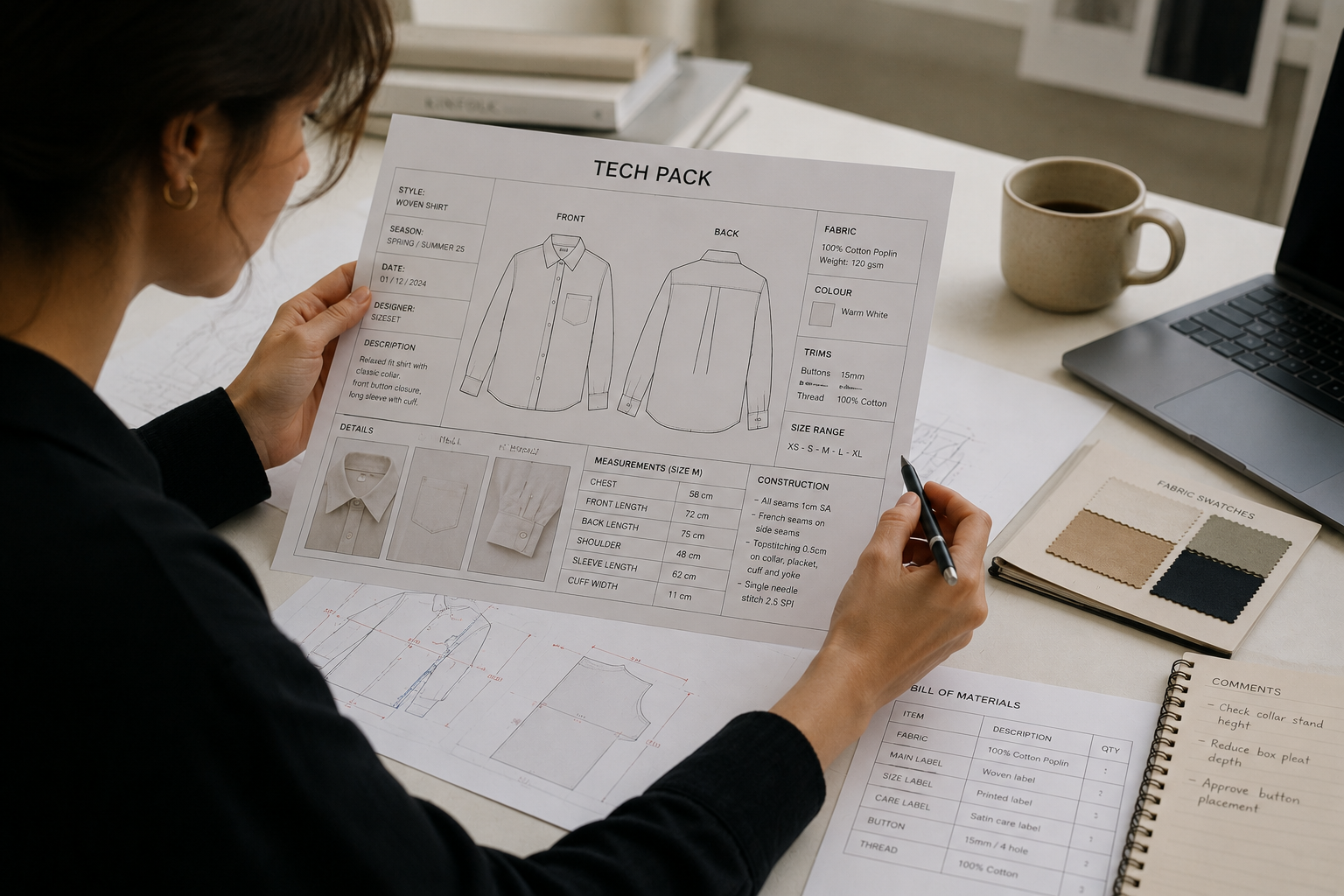
What happens when no one says exactly what they want.
When the problem isn’t patternmaking, it’s lack of clarity
There is a recurring moment in my work that almost always begins the same way.
A patternmaking request arrives. The designer is enthusiastic. The idea seems solid.
But what comes with it is only a poorly proportioned hand sketch, with no measurements, no finishing details, no fabric information and often no clear answers once questions start being asked.
At this point, patternmaking stops being a technical task and turns into an exercise in guesswork.
The issue is not lack of talent.
It’s not lack of creative vision.
It’s lack of structure.
Where communication starts to fail
Without a well-organized tech pack, every decision becomes an assumption:
-
Is the garment structured or fluid?
-
What type of seams should be used?
-
Does the total length include the waistband or not?
-
Does the fabric stretch or not?
When these answers aren’t documented, the process inevitably includes duplicated work:
redoing patterns, adjusting prototypes, revisiting decisions that should have been made before the first draft.
And here’s the uncomfortable but necessary truth:
this is not a “patternmaker’s mistake” nor an issue of being too demanding.
It’s the direct result of unresolved communication.
A tech pack doesn’t limit creativity, it protects the project
There’s a romantic (and impractical) idea that tech packs restrict the creative process.
In reality, they do the opposite.
A good tech pack:
-
translates the designer’s intent into technical language
-
reduces noise and subjective interpretation
-
saves time, money, and emotional energy
-
creates a healthier collaboration
It doesn’t exist to control.
It exists to align.
Professionalism also means being able to explain what you want
When a designer arrives with a clear tech pack, everything changes.
The conversation becomes objective.
Decisions are intentional.
The process flows.
Not because the project becomes “less creative,”
but because it no longer depends on improvisation.
If your work constantly needs to be redone, it’s worth asking honestly:
is the problem really execution or how the idea was communicated?
What truly must be in a tech pack
A tech pack is not a document created to “check a box.”
It’s a conversation held in advance between the person who imagines the garment and the one who will make it possible.
When that’s forgotten, the same frustrations always appear:
“That’s not what I meant,” “I imagined it differently,” “We can adjust it later.”
You couldn’t. It only seemed like you could.
1. Technical drawing of the garment
A weak tech pack is full of maybes.
A useful one is full of choices.
It’s not enough to draw a garment.
The drawing must have correct proportions to communicate the real intention of the design.
Whenever something is left implicit, someone else will have to decide for you.
And that person is not inside your head.
2. Measurements
Measurements are not a boring appendix.
They’re the only objective way to translate proportion, intention, and comfort.
“Short,” “loose,” or “fitted” mean nothing outside your personal context.
In a tech pack, they need to become numbers, even provisional ones.
If proportion matters, it has to be measurable.
Otherwise, it becomes interpretation.
3. Finishing details
-
Open seam or French seam?
-
Single or double hem?
-
Lined or unlined garment?
These details are not “finishing touches.”
They define the positioning of the garment and the level of care behind the product.
When finishing details are undefined, the project feels unfinished, even when it’s technically “done.”
4. Fabric
Ignoring fabric in a tech pack is like designing a house without considering the land.
Weight, stretch, drape, and behavior completely change the pattern.
It’s not the patternmaker’s responsibility to guess this later.
Even when the final fabric isn’t decided yet, material intention must exist.
A tech pack is a commitment, not an imposition
Here’s a crucial point: a well-made tech pack protects both sides.
It prevents rework, emotional wear, and that constant feeling that “no one understands each other.”
It’s not about control.
It’s about respect for the process.
When it exists, the relationship stops being defensive and becomes collaborative.
Two workflows. Same garment. Completely different outcomes.
Imagine a midi dress with sleeves.
Nothing overly conceptual. Perfectly achievable, as long as the information exists.
📌 Poorly defined tech pack
(what arrives far more often than it should)
❌General description:
Midi dress, feminine, elegant. Long sleeves. Loose fit.
❌Drawing:
– Hand sketch with undefined proportions
– Narrow sleeve drawn, without clarity if it’s fitted or stylized
– Skirt without a clearly defined hem
❌Measurements:
– None
– Verbal note: “not too short, not too long”
❌Finishing
– Not specified
– “We’ll see later”
❌Fabric
– “Something fluid”
– No weight, composition, or reference
👎Practical result
The patternmaker must decide length, sleeve width, armhole shape, neckline structure, and hem finish.
When the prototype is ready, the classic comment appears:
“That’s not how I imagined it…”
And no, it wasn’t.
But it was never clearly explained either.
📌 Well-defined tech pack
(not perfect — functional)
✔️General description:
Midi dress with a slightly A-line silhouette, designed for medium-weight fluid fabric. Long sleeves with ease at the cuff, no applied cuff.
✔️Technical drawing:
– Front and back flat views
– Defined hems and seams
– Clear sleeve width indication
– Specified neckline
✔️Base measurements (sample size):
– Total length: 120 cm
– Sleeve length: 58 cm
– Half cuff width: 22 cm
– Half bust width: 45 cm
(even if adjusted later, the intention is clear)
✔️Finishing:
– 2 cm single-fold hem
– Neckline finished with turned-in bias tape
– Internal seams overlocked
✔️Fabric:
– Viscose or lightweight crepe
– Medium weight, no stretch
– Fluid drape, no structure
👍Practical result:
The prototype doesn’t need to be guessed.
When it’s finished:
“This is exactly what I wanted, let’s just refine a few details.”
The difference between these two tech packs is not time.
It’s creative responsibility.
A weak tech pack transfers decisions to the executor.
A solid one assumes choices — even knowing some may evolve.
And here’s the hard truth:
rework rarely comes from patternmaking itself.
It comes from lack of positioning before it begins.
How should I request collaboration from a patternmaker?
Requesting patternmaking support is not just “ordering a service.”
It’s starting a technical partnership.
Doing it professionally requires more work before the request:
thinking, deciding, organizing, naming intentions.
But that initial effort saves:
-
rework
-
frustration
-
emotional wear
-
damaged professional relationships
And above all, it preserves mutual respect.
Do you need more clarity and flow in your creative process?
Reflect on these questions and implement changes so working in fashion and design stops being a constant drain.
-
What kind of mistake keeps repeating in your projects?
-
What do you expect others to “complete” for you?
-
What kind of professional relationships are you building with your technical partners?
-
How would your work change if your requests were clearer?
Thanks for reading.
See you in the next post.
Célia