

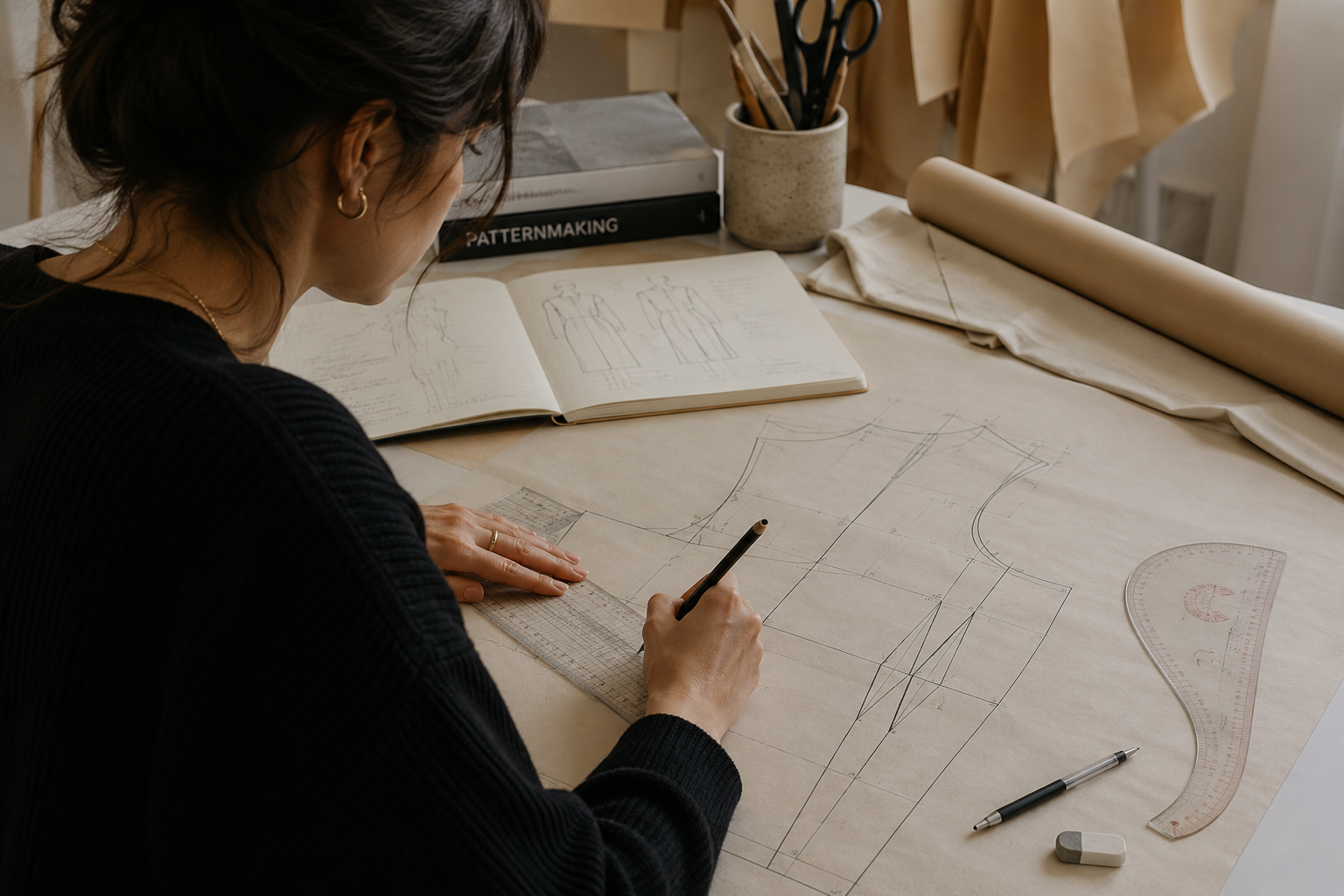
What I’ve observed while teaching patternmaking and sewing and at the same time learning new skills myself.
There are people who spend years saying they want to learn patternmaking or sewing.
They buy courses, save tutorials, bookmark resources, but never move past the first attempt.
It’s not a lack of motivation.
It’s a lack of commitment.
Motivation is a comfortable argument. It gives us good excuses to postpone:
“when I feel more inspired,”
“when I have more time,”
“when I feel more confident.”
The problem is that this moment rarely arrives.
🧶 I speak from personal experience.
Last year, I completed a training course in Clo3D (I’ll talk more about it in a future post). During the course, I was fully committed to finishing it successfully. The enthusiasm was real, every new function felt exciting, and watching everything take shape was deeply satisfying.
Until the final project was submitted.
I felt relieved. I relaxed.
And what had been frequent use of the software quickly became almost nothing.
Whenever errors appeared that I couldn’t immediately solve, or when the results didn’t match the expectations I had created, I told myself I would return to it when I was “in the right headspace.”
In practice, this only delayed my learning.
It wasn’t a lack of ability.
It was avoidance of discomfort.
The problem with depending on motivation
Motivation is emotional and unstable.
It shows up when we’re inspired, when results look good, when we buy a new book or start a new course.
And it disappears when:
-
the pattern doesn’t fit
-
the fitting goes wrong
-
the fabric doesn’t behave as expected
-
time feels scarce
-
comparison with others creeps in
If your learning depends on this emotional state, it becomes fragile.
There is no consistent progress without consistency in action.
Commitment is a decision, not a feeling
Learning patternmaking and sewing requires an agreement with yourself.
Not with your motivation, but with your commitment.
Commitment means choosing to continue even when there’s no enthusiasm.
Even when the exercise is boring.
Even when the result isn’t beautiful.
Some strategies that actually work:
-
setting realistic practice schedules
-
accepting that mistakes are part of the process
-
repeating the same pattern or stitch more than once
-
practicing details before trying to create complete garments
It’s not romantic.
But that’s how foundations are built.
Learning is not linear
Another common mistake is expecting constant and visible progress.
In patternmaking and sewing, there are phases where it feels like we’re not moving forward when, in reality, we’re consolidating knowledge.
These periods of apparent stagnation are moments of internal organization.
Those who quit at this stage rarely fail because of a lack of talent.
They fail because of a lack of medium-term commitment.
What truly separates those who learn from those who stay stuck in “I want to learn” is:
-
continuous practice
-
willingness to repeat
-
acceptance of errors as part of the process
-
patience with long-term processes
A realistic commitment
You don’t need to practice every day for hours.
You need consistency.
Three short practice sessions per week, sustained over months, are far more effective than bursts of enthusiasm followed by abandonment.
Commitment is not intensity.
It’s continuity.
🧶 Returning to my own process with Clo3D:
when I stopped waiting for motivation and started creating a minimal, realistic commitment, my relationship with the software changed completely.
I set specific times to practice, even knowing that some sessions wouldn’t “produce results.” I accepted that some days would be only for making mistakes, testing, and not solving anything. I stopped demanding quick outcomes and focused instead on repetition.
Over time, errors stopped being a blockage and became part of the process. My use of Clo3D became consistent and, interestingly, much more enjoyable precisely because it no longer depended on initial enthusiasm.
Progress came after consistency, not before.
For reflection
If you want to learn patternmaking and sewing, the honest question isn’t:
“Am I motivated?”
It’s this:
Am I willing to learn even on the days when I don’t feel like it?
The answer to that question is what truly determines whether you’ll move forward.
And you:
what do you do when you need to learn without motivation?
Do you create a structure to continue, or do you stop and wait for motivation to return?
Thanks for reading.
See you in the next post.
Célia